The Problem
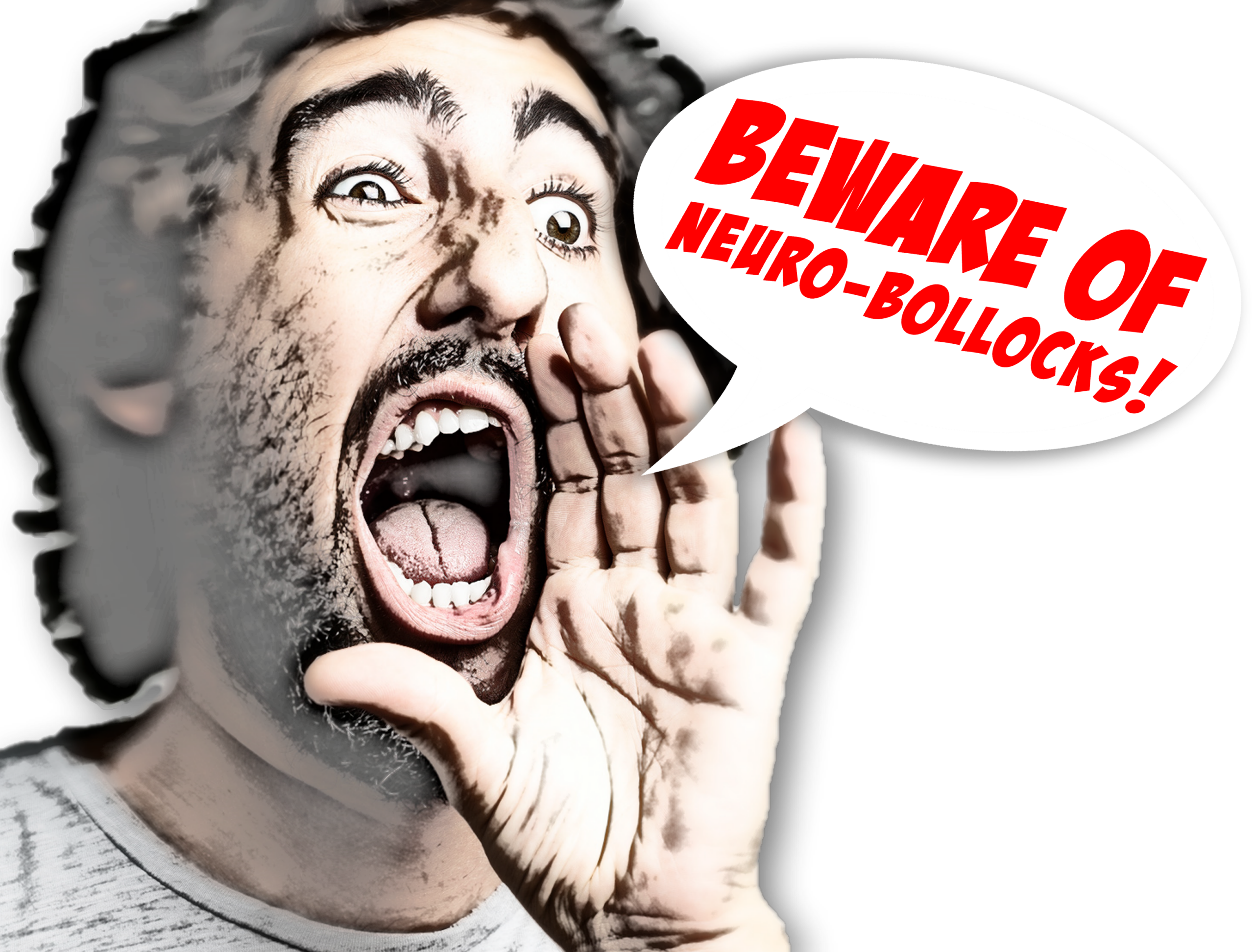
Neuroscience has become one of the most powerful legitimising forces in popular culture. Add the word “neuro” to almost anything, include a brain scan image, and people become substantially more likely to believe what they are being told, even when the underlying claims are vague or meaningless. Manie Bosman’s 2021 article for the Strategic Leadership Institute takes direct aim at this phenomenon, cataloguing nine prevailing beliefs about the brain that continue to circulate in management consulting, coaching, education, and self-help despite being either thoroughly debunked or unsupported by genuine scientific evidence.
This is not a peer-reviewed study but a well-referenced practitioner piece drawing on over 170 sources. It is included here because the myths it addresses are directly relevant to anyone working in people development, leadership, and organisational practice, where neuromyths thrive with particular persistence.
The Nine Claims, and What the Science Actually Shows
Left-brain, right-brain profiling. The idea that people are either left-brained (logical, analytical) or right-brained (creative, intuitive) originated in misinterpretations of neuropsychologist Roger Sperry’s split-brain research. A 2013 fMRI study of over 1,000 participants found no evidence of hemispheric dominance. We use both hemispheres for virtually every task. Any personality or cognitive profile built on brain dominance is, in Bosman’s phrase, neurobollocks. Even Ned Herrmann, the originator of the Whole Brain Model, conceded in 1982 that it is “today entirely a metaphor” (Bosman, 2021).
Learning styles. The claim that people learn best when information is delivered in their preferred sensory modality, visual, auditory, or kinaesthetic, has been pushed in training and education for over fifty years. There is no validated scientific evidence that preferred learning styles are related to dominance in any brain area, and no empirical evidence that matching instruction to learning style improves outcomes. Brain research consistently shows that learning is enhanced when multiple senses are engaged, the opposite of what learning styles theory recommends (Bosman, 2021).
Multiple intelligences. Howard Gardner’s theory of nine distinct intelligences has genuine intuitive appeal and has been widely adopted in education. However, it lacks empirical scientific support, and neuroscientists have pointed out that reducing the complexity of individual cognitive differences to nine neat categories is both implausible and oversimplified. Critics have suggested Gardner was simply relabelling abilities, talents, and skills as “intelligences” to make the theory sound more scientifically substantial than it is (Bosman, 2021).
Three brains. The claim that we have a head-brain, a heart-brain, and a gut-brain, and that aligning all three improves decision-making and emotional intelligence, has no neuroscientific basis. While the heart and gut do contain rudimentary nervous systems, neither qualifies as a brain by any serious scientific definition. The heart’s intrinsic nervous system contains roughly 40,000 neurons, fewer than half the number in a fruit fly’s brain. Claims that these systems process emotions or contribute to intuition and decision-making go well beyond anything the evidence supports (Bosman, 2021).
The 10% myth. The belief that we use only 10 percent of our brains is one of the oldest and most persistent neuromyths, kept alive partly by Hollywood. Brain imaging has found no inactive regions in a healthy brain. We use all of it. A 2013 survey found that around 65 percent of Americans believed this myth (Bosman, 2021).
The Mozart effect. The original 1993 study found a short-term improvement in spatial reasoning after listening to Mozart, lasting about 10 to 15 minutes, not a lasting boost to general intelligence. Subsequent research showed the effect applies to any music a person enjoys, not specifically Mozart or classical music, because enjoyable music activates areas involved in spatial processing. A 2010 meta-analysis concluded there is little evidence for a specific performance-enhancing Mozart effect (Bosman, 2021).
Brain development stops at puberty. This was conventional wisdom until the 1970s. It is wrong. Because of neuroplasticity, brain development and adaptation continue well into adolescence and adulthood, and throughout life. Early stimulation matters, but deficits in early years do not permanently determine outcomes (Bosman, 2021).
The triune brain and the lizard brain. Paul MacLean’s theory that the human brain evolved in three distinct layers, reptilian, old mammalian, and new mammalian, each competing for dominance, has been extensively critiqued and largely abandoned by neuroscience. MacLean’s evolutionary timeline was wrong, his structural claims were incorrect, and the notion that we are periodically hijacked by an uncontrollable reptilian brain has no scientific support. Research confirms that humans have the innate capacity to inhibit automated neural responses. We are not controlled by a lizard in our heads, as Bosman puts it, unless we choose to be (Bosman, 2021).
Brain training apps. This is the one area where Bosman withholds a firm verdict. The scientific evidence on whether brain training programmes produce transferable real-world benefits is genuinely ambiguous, with some studies finding meaningful effects and others finding none. The core question, whether solving online puzzles improves performance on unrelated cognitive tasks in everyday life, remains unresolved. The jury is still out, and the booming industry has run well ahead of the evidence (Bosman, 2021).
Why These Myths Persist
Studies show that neuromyths are astonishingly prevalent even among professionals. Research across teachers in five countries found that between 93 and 97 percent believed the learning styles myth. A survey of around 3,000 members of the general public found that 68 percent endorsed neuromyths. Studies of sports coaches found similar patterns. These are not fringe beliefs held only by the credulous; they are mainstream assumptions held by educated professionals who work directly in fields where the myths cause practical harm (Bosman, 2021).
The persistence reflects something important about how neuroscientific framing operates. People are more likely to accept scientific claims when they are accompanied by brain images and neuroscientific language, even when the explanation is vague or the claims are false. Opportunistic marketers and practitioners have exploited this systematically, adding “neuro” to product and service names without the underlying science to justify it.
Why It Matters
The practical consequences of neuromyths are not trivial. They direct the attention and resources of leaders, teachers, coaches, and organisations toward approaches that do not work and away from approaches that might. Learning styles frameworks shape how training is designed. Brain dominance profiles shape how people are categorised and developed. The lizard brain metaphor shapes how emotional regulation and leadership behaviour are understood and taught. None of these have a legitimate neuroscientific basis, and all of them carry costs (Bosman, 2021).
Bosman’s concluding advice is straightforward: be sceptical of anything described as neuro-based or brain-based, demand references to original research, and treat the presence of neuroscientific framing as a reason to look harder rather than a reason to trust more.
Reference
Bosman, M. (2021). Neurobollocks: Be careful not to fall for all things ‘brainy’. Strategic Leadership Institute. https://www.stratleader.net/sli-blog/neurobollocks